Wilhelm Smith|1867-1949
Wilhelm Smith, born 25 April 1867 in Karlshamn in Blekinge, died 17 January 1949 in Märserum in Åryd parish in Karlshamn municipality, Blekinge, was a Swedish artist and art professor (professor of painting) at the Art Academy in Stockholm, where he taught under nearly twenty years. His younger brother, the artist Ernst Smith (1868–1945), was his pupil. Biography The Art Academy's building at Fredsgatan 12 in Stockholm, where Smith himself studied and then was a professor. Interior of Studio Académie Julian. Oil painting by the school's pupil Marie Bashkirtseff (1881). Bashkirtseff is the figure in black in the lower right corner. The painting is today in the Dnipropetrovsk State Art Museum, Dnipropetrovsk. Motives from the Paris salon Műcsarnok (Palace of Art or Kunsthalle Budapest) at Heroes' Square (Hősök tere) in Budapest. Smith exhibited at Műcsarnok at an international art exhibition in 1906.
Wilhelm Smith was the son of the landowner Gustaf Smith and Eveline Wirén. He was unmarried. In the years 1886–1889 he studied at the Art Academy in Stockholm. He then continued at the Académie Julian in Paris and was then a student of Léon Bonnat. After his time in Paris, he stayed on Capri for nine months and during this time painted small genre pictures in French technique, Children playing with a crab (1891). In the same year, 1891, Wilhelm Smith participated in the Paris Salon where he received an honorable mention. Other international appearances include an exhibition of Swedish 1880s and 1890s paintings at the Royal Academy of Arts in London in 1924. This was followed by study trips to Italy, Germany, the Netherlands, Belgium and Tunisia. Professor of painting at the Academy of Fine Arts 1913-1932 In 1910 Wilhelm Smith became a member of the Academy of Fine Arts and in 1913
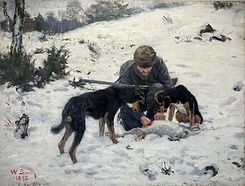
He was appointed professor of painting at the Academy of Fine Arts and he was then active as an art professor at the academy for nineteen years, during the years 1913-1932. Work Smith was a genre and landscape and portrait painter. His painting is vigorous, but has well-balanced color and monumental stance. After his years at the Académie Julian in Paris in France, Smith had been influenced by French Impressionism. He pictures from Swedish everyday life, several paintings with fishermen from Blekinge, atmospheric Stockholm motifs, winter landscape with motifs from Dalarna with colorful paintings of the day with French and Italian motifs. In addition, he painted portraits with a powerful style. Wilhelm Smith is almost forgotten today.
In the auction market, Smith is rare. Exhibitions In March 1905, Wilhelm Smith organized a solo exhibition together with Erik (Ecke) Hedberg and Pelle Swedlund in the Konstnärshuset at Smålandsgatan 7 in central Stockholm. In an article in the newspaper Idun on March 9, 1905, the following text can be read (excerpt): "Wilhelm Smith also feels strongly united with our country, but he has one foot in Italy. A few years ago he received a scholarship and stayed in Rome and Venice, from where he sent home his large canvas Osteria[9], as the National Museum bought in. Even Bruges captivated him with its solemn silence and imaginative medieval architecture, and he paid a visit there as a result of, among other things, the musty painted canvas Green Square in Bruges. Among his more noted works at this exhibition can be counted the painting Threshing shown here and the portrait by Mr. Erik Hedberg (Ecke Hedberg), both painted with an honest pursuit of truth, which inspires sympathy." During his life, Wilhelm Smith participated in several international art exhibitions, including in the Paris Salon in 1891 and in Budapest in 1906. Furthermore, Wilhelm Smith exhibited at the Baltic Exhibition in Malmö in 1914, the Venice Biennale in 1920, and the Royal Academy of Arts in London in 1924. From September 6 to October 14, 1979, Wilhelm Smith's posthumous work participated in an exhibition at Prins Eugen's Waldemarsudde at the same time as the Finnish painter, printmaker and sculptor Hugo Simberg (1873-1917) and sculptor Sven Sahlberg (1909-2008). Hugo Simberg was mainly active in symbolism. Sven Sahlberg painted portraits, figure compositions, landscapes from Öland, interiors and still lifes, He also made glass decorations. Sahlberg's public decorations include Ränta på renta, a copper sculpture, on the facade of Klarabergsgatan 23 on Norrmalm in Stockholm.
Represented National Museum in Stockholm: Play (1893), Winter Eve (1894), Evening Atmosphere (1897), Coal Drivers in Bergslagen (1897), Italian Blacksmiths (1898), Winter Day in Dalarna (1897), Osteria (1902) and Market Scene (1910) ), as well as scenes from fishing life in Blekinge. Blekinge museum, Wilhelm Smith represented with the oil painting Market (1910). Belongs to the State Museums of Art. Gothenburg Art Museum : Lazzarons, In Brygge, Grönsakstorget in Brygge (1900) and Threshing (1902). Malmö museum: Italian country folk Karlskrona Museum Gävle museum Karlshamn municipality, the town hall and the city library Småland Museum
